While visiting my parents in Chapel Hill, North Carolina in late November, Herman Greene, who directs the Center for Ecozoic Studies, a group based on the work of “ecologian” Thomas Berry, invited me to give a salon at the home of Charles and Dianna Coble. They asked me to make a presentation and enter into conversation with the participants on this topic: “Given your long commitment to sustainability
You as Creature: What is biocentrism?
A reflection on our creaturehood, as I think of my two daughters growing up in this fast-changing world:
How difficult it has become today to be what you are: a creature in a territory to which it belongs. We pass a hundred billboards flashing the things you must possess. Kids compete against Separation-programmed kids for grades and teacher-praise, hardly anyone aware their world is imagined, through the mind of one Species alone. On social media, we have become the conjunction of a set of data points into which marketers drop baited hooks. In short, we are informed that you are something that you really are not, and then further informed that that “something” is by definition not good enough. “Never stop improving” is how one major corporate motto captures the cradle-to-grave ethos of Sapiens.
This 1-minute video from our land here in Samaipata captures something of how our daughter is growing up outside of this ethos. I hope you enjoy it.
Law of Detachment
“Your life will be in flow, if you let go. Everything that is meant to follow you will do so,” reads the small, fading post-it note taped to my computer. I first heard the quote from a friend about two years ago. At the time, she was going through a rather major life transition – finishing up her PhD dissertation, accepting a teaching job in a new city, and breaking up with her partner of five years. She shared the quote with me while we sat on a bench in a beautiful urban sanctuary in downtown Denver, Colorado – the Denver Botanic Gardens. As we sat together, under the warm Colorado sun, stealing glimpses of the still snow-capped Front Range, I began to study her. Amidst all of the external change going on in her life, I saw (and actually felt!) in her a deep feeling of inner-calm, an admirable congruity between her values and her actions. She had a grace to the way she moved e ffortlessly through her days, and a strong sense of “warrior presence”, something I explored in Twelve by Twelve as one’s ability to maintain beauty and control in their interior space, through being fully present in the moment.
Slow Movement on the Rise!
Fast and slow are physical attributes. But they are also adjectives that convey societal values. 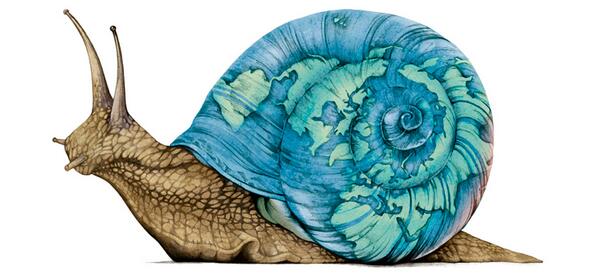
The Slow Movement’s roots can be traced back to the original Slow Food movement, which began in the late 1980s in Bra, Italy when a group of young and passionate foodies and social and environmental activists protested the construction of a McDonald’s in their town. They joked, “If there exists a philosophy of fast food, why not promote the idea of slow food?”
In 1989, this vibrant and impassioned group created the manifesto for the international Slow Food movement. In their manifesto, Slow Food voiced a strong opposition against globalization, namely the negative, homogenizing cultural and societal forces and the destructive environmental impacts of large-scale, industrial monoculture farming practices.
Seven Ways to Have More by Owning Less
Inconspicuous consumption, or what lunching ladies have to do with social web karma. By Maria Popova.
Stuff. We all accumulate it and eventually form all kinds of emotional attachments to it. (Arguably, because the marketing machine of the 20th century has conditioned us to do so.) But digital platforms and cloud-based tools are making it increasingly easy to have all the things we want without actually owning them. Because, as Wired founder and notable futurist Kevin Kelly once put it, “access is better than ownership.” Here are seven services that help shrink your carbon footprint, lighten your economic load and generally liberate you from the shackles of stuff through the power of sharing.
What’s it like to live in a 12’ by 12’, off-the-grid house?
Three years ago, I returned to America after a decade of aid and conservation work in Africa and Latin America. Abroad, I’d seen, starkly, the grave impact the global economic system was having on our environment—Amazon rainforests clear-cut for fast-food cattle, African rivers poisoned by multinational mining—and began asking myself a daunting question: How could humanity transition to gentler, more responsible ways of living by replacing attachment to things with deeper relationships with people, nature, and self?
Fortunately, I stumbled upon someone with some clues: Dr. Jackie Benton (a psudonym, per her request). I met this slight, sixty-year-old physician, she was stroking a honey bee’s wings in front of her twelve-foot by twelve-foot, off-the-grid home in North Carolina.